Disney Just Laid Off 1,000 People — Why Real Animators Matter More Than Ever in 2026
The April 2026 cuts hit the artists who literally invent how Marvel films look. The headlines are scary. The lesson underneath them is the opposite of what most people think.
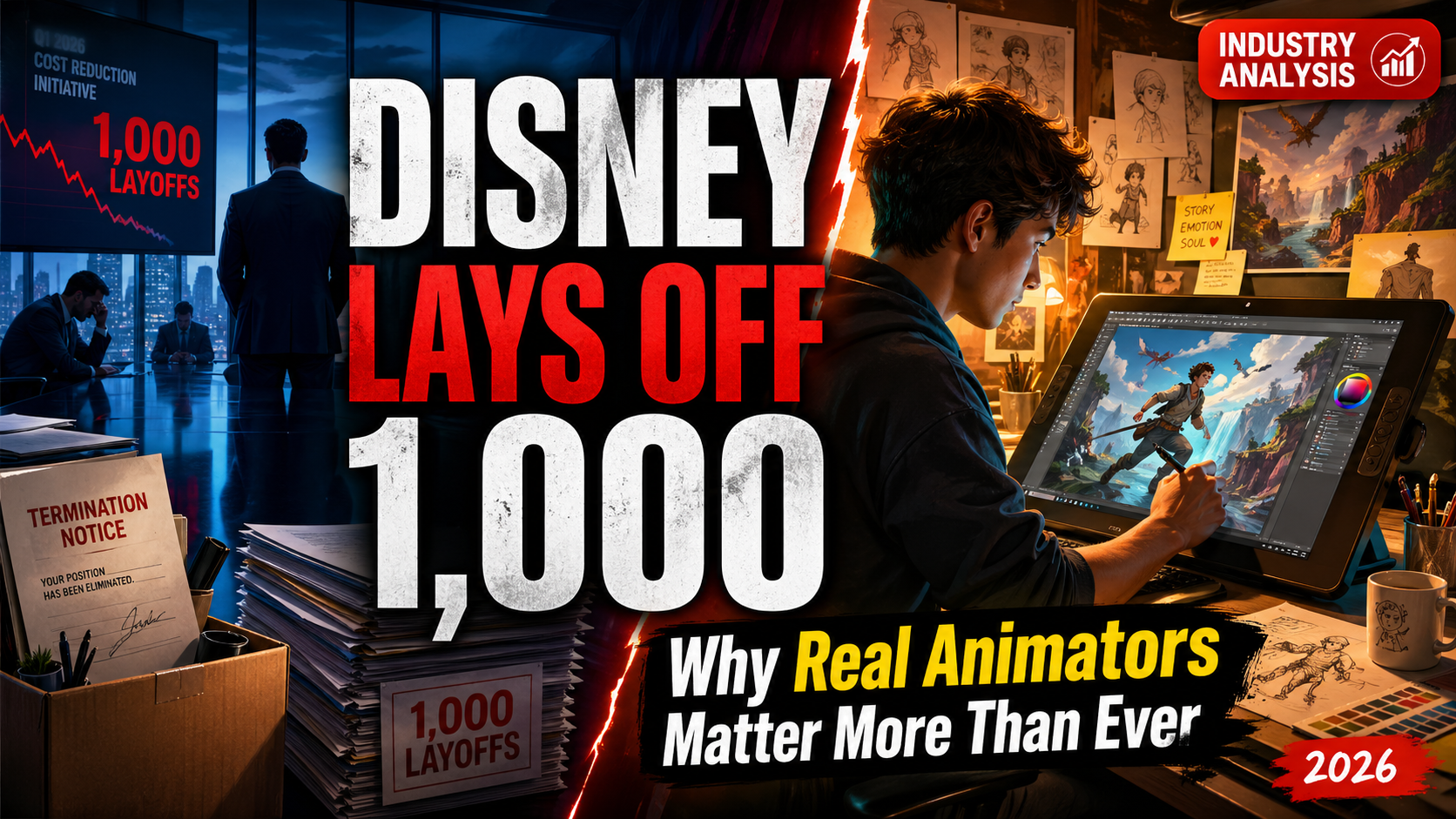
On April 15, 2026, Disney's new CEO Josh D'Amaro announced roughly 1,000 layoffs across the company — and Marvel Studios' Visual Development department, the artists who literally invent the look of every Marvel film, was hit hardest.[1] The headlines are scary. The lesson underneath them is the opposite: the fundamentals real animators teach are now more valuable than they have been in a generation. Here's why.
The headline shaking the creative world
Disney confirmed on April 15, 2026 that approximately 1,000 employees would be cut across film, television, ESPN, product, technology, and corporate functions.[1] Marvel Studios was reportedly hit hardest, with around 8% of staff let go, particularly in visual effects. Days later, Marvel's Director of Visual Development, Andy Park, departed after 16 years — a name many comic-and-film fans recognize from over a decade of Marvel concept art.[2]
These were not interns or temps. The cuts hit artists, illustrators, character designers, and environment designers — many with a decade or more at the company. In other words: the people who draw the worlds before the cameras ever roll.
CEO Josh D'Amaro framed the move as a step toward a more agile, technology-enabled workforce. The financial press read between the lines clearly: AI tools, real-time pipelines, and a shift from in-house teams to project-based freelancing.
If you are the parent of a kid who loves to draw, or a teen wondering whether to chase animation as a career, this news lands hard. It should also land honest — and the honest read is more hopeful than the headlines suggest.
This is not just a Disney story
To understand what is really happening, zoom out one frame.
In a single week in April 2026, three major entertainment companies announced sweeping cuts. Disney announced up to 1,000 cuts, Sony Pictures confirmed several hundred, and Bad Robot is downsizing across its operation. Snapchat slashed roles around the same time, citing AI directly. Artnet cut roughly a third of its newsroom and shifted toward AI-aggregated tools.
Different companies. Same week. Same underlying engine: AI is now woven into production pipelines, and studios are restructuring around what humans do that machines cannot.
This is the part the doom-headlines skip — and it is the part parents and students need to understand to make smart choices.
What is actually being automated (and what is not)
It helps to look inside an animation pipeline and ask, honestly, where AI is taking over.
The mechanical layer
- In-betweening — frames between key poses
- Rotoscoping & clean-up — tracing, isolating
- Standard look-dev — 2D refs to PBR 3D
- Routine VFX touch-ups — matte paint, simple comp, color
The creative layer
- Memorable character design — silhouette, shape, appeal
- Acting — timing of a blink, weight of a shoulder
- Composition — directing where the eye goes
- Storyboarding — making the emotion land
- Draftsmanship — gesture, anatomy under pressure
- Judgment — knowing why a shot works
These are real, paid jobs that used to fill 60–70% of a production schedule. According to industry coverage from VFX Voice and others, studios are using AI to handle roto, clean-up, and even some lookdev — not to replace artists, but to free them for creative work.[4]
AI is replacing the steps. It is not replacing the eye.
Test your animator's eye
Three quick scenarios. For each one, decide: is this the kind of work AI can handle, or does it still need a trained human?
Can you spot the difference?
No tricks. Just real distinctions every animator makes daily.
1. Filling in 23 frames of motion between two perfectly-drawn keyframe poses of a character mid-jump.
2. Designing a brand-new character whose silhouette is instantly recognizable when you see it as a black shape against a colored background.
3. Deciding whether a character's blink should happen before or after they turn their head — and how that choice changes whether the audience reads them as confident or nervous.
Why fundamentals just became the most valuable currency
Here is the counterintuitive twist studios are quietly betting on.
When AI handles the grunt-work, the artists who remain need to be better, not worse. They have to direct the tools instead of being directed by a senior. They have to make hundreds of small creative judgments per day — pose, shape, contrast, color, timing — that no prompt can specify.
That judgment is built on exactly the foundation animation schools have always taught:
The 12 principles, in motion
Click any principle below to see it animated. These are the rules every Disney animator learned — and the same rules our students learn at EAA, regardless of whether they're heading toward 2D, 3D, anime, or game design.[5]
Interactive · Click to Animate
The 12 Principles of Animation
Codified at Disney by Ollie Johnston & Frank Thomas — still the foundation of every studio pipeline today.
Squash & Stretch
The most fundamental principle. Objects deform on impact and elongate during fast motion — without it, animation feels stiff. Watch the ball flatten when it hits the ground and stretch as it rises.
How a Disney animator stages a character
Woody Woodman — animator on Mulan, Tarzan, and Brother Bear — walks through how he approaches the early sketch phase and decides where a character lives on the page. This is the kind of feedback that doesn't come out of a prompt.
These are the same principles taught at Disney for nearly a century. They are also the principles that decide whether an AI-assisted shot looks like a film or a stock asset.
A real-time engine like Unreal can render a photorealistic shot in seconds. It cannot tell you whether the shot is good. That is still on the artist. Which means the artist who can answer that question — quickly, reliably, defensibly — is exactly the one studios still need.
What this means for parents and teens making decisions right now
If your kid is eight years old and drawing dragons in the margins, do not pull them off the path. Adjust the path. Here is the practical version:
The students who will thrive in an AI-assisted industry are the ones whose drawing, observation, and storytelling skills are non-negotiable. That is not learned from YouTube tutorials. It is learned from a teacher who can look at a sketch and say the elbow is wrong, the weight is on the wrong foot, and here is why the pose feels stiff.
A degree on the wall is not the same as having animated a scene that 100 million people saw in a theater. The difference is in how feedback gets given — vague vs. specific, theoretical vs. earned.
Schools like Ringling, SCAD, CalArts, and Full Sail are increasingly looking for evidence that a student can think — composition choices, character ideation, sequential storytelling — not just polished single images. (We wrote a full guide on this: see Building a Portfolio at Any Age.)
Maya, Blender, Photoshop, Animate, Unreal — yes. But also pencil, paper, gesture practice, life drawing. The students winning right now are dual-fluent.
They are a verdict on a specific kind of role at a specific scale of company in a specific quarter. The animation industry itself, globally, is still growing. New jobs are being created; they just look different.
Find the right animation path for you
Everyone starts somewhere different. Answer four quick questions and we'll point you toward the EAA course track that fits your goals — whether you're a kid who just discovered drawing, a teen building a college portfolio, or an adult considering a creative second act.
What animation path is right for you?
Built by EAA's Disney-trained instructors.
Where are you in your journey today?
Which of these excites you most when you watch a movie?
Which style pulls you in most strongly?
What's your end goal?


Where to start in Orlando — or from anywhere
Elite Animation Academy was founded in Orlando in 2012 specifically to teach the fundamentals the way Disney teaches them. Our lead instructor Woody Woodman animated on Mulan, Tarzan, and Brother Bear. Our other instructors come from Marvel, Disney Feature Animation, and the broader Orlando-area pipeline that built the modern theme-park and animation industry.
Character design with a former Disney pro
A peek inside summer camp at EAA — Woody Woodman teaching character design to students. This is the kind of one-on-one critique you don't get from a tutorial.
What that means in practice for a student:
- Drawing fundamentals taught first. Every path — 2D, 3D, anime, character design, game art — starts with the same foundation, because it has to.
- Real critique from people who have shipped. Not "great job," but specific notes that move work forward.
- Both traditional and digital tracks. Pencil and Cintiq, side by side. Adobe, Maya, Blender, and Unity all in the curriculum.
- In-studio in Orlando or live online from anywhere. Same instructors, same roadmap.
- Step Up for Students provider. Florida families using FES-UA or New Worlds funds can cover the full cost of summer camps.
Summer 2026 camps run June 1 – August 7, ten weeks, four different subjects every week. Year-round courses run in-studio and online for ages 8 and up, including adults. The full course roadmap from beginner drawing to advanced 3D is laid out here.
If you are weighing whether to invest in your kid's creative path right now, in this exact news cycle, here is the short version: the world needs better-trained animators, not fewer. The students who learn the fundamentals from real animators today are the ones studios will be hiring — and the ones building the next generation of independent work — for the next twenty years.
Ready to start your child's animation path?
Spots in Summer 2026 camps fill weekly — some weeks are already at capacity.
Frequently asked questions
Is animation still a good career in 2026?
Yes — but the career looks different than it did ten years ago. Studio in-house roles are tightening; freelance, indie, YouTube-native, gaming, immersive media, and education-tech roles are expanding. Fundamental skills (drawing, story, character) plus tool fluency (Maya/Blender/Animate/Unreal) plus adaptability is the winning mix.
Will AI replace animators?
AI is replacing specific tasks inside the pipeline — in-betweening, roto, clean-up, some lookdev. It is not replacing the creative judgment that makes a shot, a character, or a story work. The animators who learn to direct AI tools instead of compete with them are the ones thriving.
What should my kid focus on right now?
Drawing fundamentals first, always. Then the 12 principles of animation. Then digital tools — Photoshop and either Animate (2D) or Maya / Blender (3D). And consistent portfolio work from the start, not just the year before college applications.
Does Elite Animation Academy accept Step Up for Students?
Yes. EAA is a registered Step Up for Students provider, including FES-UA and New Worlds Reading scholarships. Eligible Florida families can use scholarship funds to cover summer camps and year-round courses. Contact us before booking to verify your eligibility.
Are online classes as good as in-studio?
Yes — same instructors, same roadmap, same critique-based teaching style. Online students from across the U.S. and internationally have gone on to Ringling, SCAD, and Valencia/UCF. In-studio students get the studio environment and equipment; online students get flexibility and travel-time back.
Sources & further reading
- Disney announces ~1,000 layoffs across film, TV, ESPN, technology, and corporate. Coverage from major trade and financial press, April 15, 2026. See reporting at The Hollywood Reporter, Variety, and Fox Business.
- Marvel Studios reportedly hit hardest (~8% of staff); Director of Visual Development Andy Park departs after 16 years. April 2026. Reporting via Variety and Deseret News.
- Generative-AI animation market sizing: $2.37B (2025) → $3.23B (2026), 36.1% CAGR. Industry analyst reports including Grand View Research and Precedence Research.
- AI integration into VFX and animation pipelines (in-betweening, rotoscoping, clean-up, lookdev). Industry coverage by VFX Voice (publication of the Visual Effects Society) and related trade press.
- The 12 Principles of Animation — codified by Frank Thomas & Ollie Johnston in The Illusion of Life: Disney Animation (Abbeville Press, 1981). Foundational text taught at Disney, Pixar, and every major animation school today, including Elite Animation Academy.
All external citations open in a new tab. Coverage of breaking news evolves; figures and details reflect reporting as of the publish date above.


