
Anime Studios Are Apologizing for Using AI in 2026 — Here's What That Means If Your Kid Loves Manga
WIT Studio just replaced an opening sequence. Toei walked back AI plans. Beloved mangaka are leaving social platforms. And yet the anime/manga market more than doubled in five years to over $30 billion. Here's the real story underneath the headlines — and what aspiring manga artists actually need to learn now.
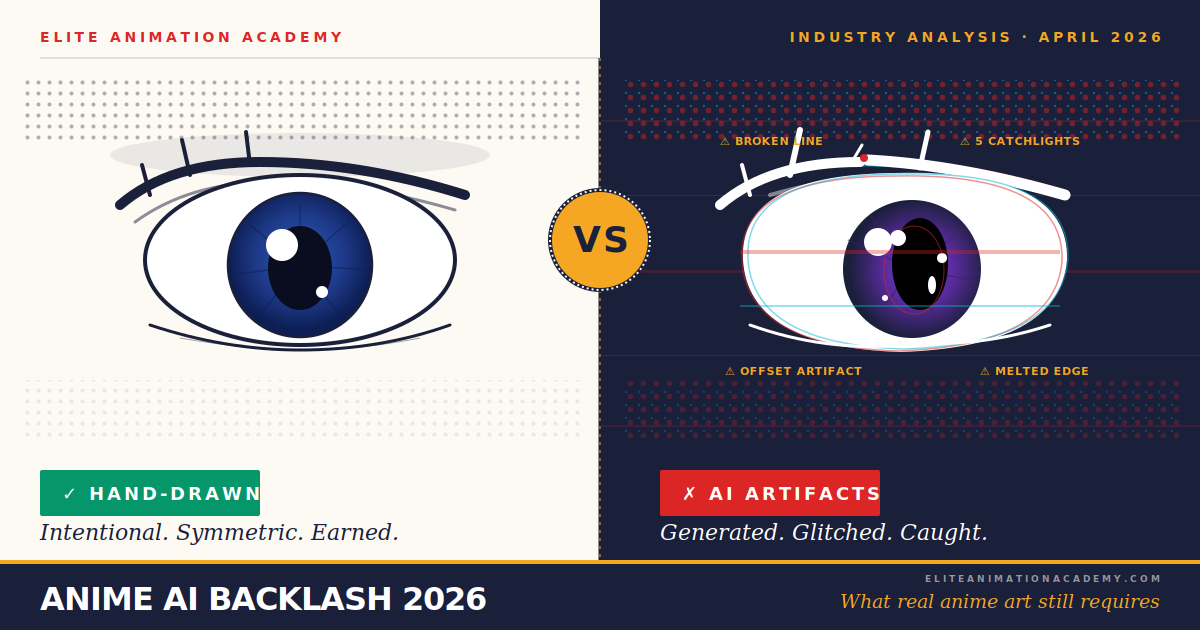
In April 2026, WIT Studio — makers of Attack on Titan and other beloved anime — publicly apologized and replaced an entire opening sequence after fans caught generative AI in Ascendance of a Bookworm Season 4.[1] They're not alone: Toei Animation faced backlash over AI plans, mangaka Boichi left X over AI scraping, and 38% of Japanese animation professionals fear AI job losses while 64% of global fans say they worry about losing human emotion in designs.[2] Meanwhile the industry has more than doubled to $30+ billion globally. For kids and teens who love anime/manga and want to draw it themselves, the takeaway is direct: the human craft is more valuable than ever — but only if you build it right.
Prefer to listen? Pip the Pencil breaks it down.
The 2,400-word version is below. The 6-minute audio breakdown — anime AI controversy, the four diagnostic AI tells, and what aspiring manga artists should actually be learning right now — is in the player. Same thesis, faster delivery, hosted by EAA's mascot Pip the Pencil.
What just happened at WIT Studio
On April 4, 2026, the long-anticipated fourth season of Ascendance of a Bookworm debuted on Crunchyroll and major streaming platforms. The animation was being handled for the first time by WIT Studio — the team behind Attack on Titan, Vivy: Fluorite Eye's Song, and Moonrise — one of the most respected anime studios in Japan.[1]
Within a week, fans noticed something was off about the opening sequence. Specific frames showed the telltale artifacts of generative AI: melted background details, inconsistent line weights, geometry that didn't quite line up between frames. The accusations spread quickly across X, Reddit's r/anime, and Japanese fan communities.
WIT Studio's response was unusually direct. They confirmed that generative AI had been used for certain background cuts in the opening, took full responsibility for the oversight, and — most strikingly — replaced the entire opening sequence with a new version that did not use AI.[1] The studio also publicly stated that they "do not authorize the use of generative AI in any of their works" going forward.
An anime studio in 2026 had to apologize and re-do an opening because fans could SEE the AI in the work. That's the story.
For an industry that built its global reputation on obsessive craft and hand-drawn artistry, this was a watershed moment. WIT Studio didn't just acknowledge a production shortcut. They publicly declared a position: generative AI is not authorized in their creative process. The opening they replaced wasn't from a no-name production — it was from a studio at the top of the industry, on a beloved franchise, with millions of viewers watching.
This isn't isolated — the pattern across 2026
The WIT Studio apology is one data point in a much larger story. Across 2026, the anime and manga industries have been wrestling publicly with AI in ways that would have been unthinkable two years ago.
2026 AI Controversies — Anime & Manga Industry
The pattern: nearly every major studio, mangaka, and IP holder is now defining a public position on AI. Some are saying "yes, with disclosure." Some are saying "absolutely not in our work." Almost none are quiet anymore. That's a sea change from even 18 months ago, when the industry was experimenting silently.
The $30B paradox — why this matters
While the AI controversies dominate fan discourse, the broader anime/manga market is in the strongest growth period in its history. The numbers tell two stories at once:
Global anime/manga industry has more than doubled in five years. Driven by international streaming, merchandise, theatrical releases, and a generation that grew up with the medium.[2]
of Japanese animation professionals fear AI job losses. Only 12% of voice actors feel their likeness is meaningfully protected from AI cloning.[6]
of global anime fans are worried about losing human emotion in AI-touched designs. 52% think AI could improve technical animation quality — but the trade-off scares them.[6]
Look at the same two trends side by side: a market that's exploding, and a workforce that's nervous. That's the paradox. And it's exactly why this is the wrong moment to be a casual hobbyist hoping to "go pro someday." The studios that win the next decade will be the ones with clearly differentiated human craft. The artists who win will be the ones who can prove, on the page, that they bring something a prompt can't.
For kids and teens who already love drawing manga in their notebooks every day, this is the most consequential moment of their creative lives. Not because the industry is in danger — it isn't — but because the path between "I draw a lot" and "I can work professionally" is being reshaped right now. The kids who build real fundamentals over the next two summers will have a structural advantage. The kids who only use AI tools to "do" art for them will have nothing.
Anime AI Tells Decoder — what trained eyes catch
Six anime-specific giveaways. Different from generic AI image tells because anime has its own conventions — and AI gets those conventions almost right, which is exactly what makes the failures so visible to trained viewers. Click any card to learn what to look for.
Interactive · Click to Learn
6 Anime AI Tells Every Trained Viewer Catches
These come from real diffusion-model failure modes — the kind only anime fundamentals reveal.
Eyes & Pupils
The most diagnostic tell in anime. Real mangaka draw eyes with intentional asymmetry that reads as expression — a slightly higher catchlight, a pupil that tilts toward the focal target. AI generators produce eyes that are almost symmetric but with weird mismatches: different catchlight shapes, pupils pointing at slightly different angles, irises with patterns that don't repeat correctly. Trained viewers catch this within seconds.
What real anime art actually requires
Anime and manga look stylized — sometimes deceptively simple. They aren't. Behind the surface style is fifty years of accumulated craft tradition, codified into specific techniques that take years to master. Here's the substrate underneath the genre.
Shape language
Round shapes read as friendly, soft, vulnerable. Sharp angular shapes read as dangerous, cold, threatening. Anime character designers spend their early careers learning to communicate personality through silhouette alone — before a single detail is added. Look at Witch Hat Atelier or Dandadan: every character is identifiable from their silhouette at any distance. AI generates silhouettes that look generally like anime characters but cannot consciously communicate a character's role through shape.
Expression sheets
Professional anime production requires every main character to have a documented set of canonical expressions — joy, anger, confusion, embarrassment, determination, and the specific emotional beats that recur in the story. These are drawn by hand, refined, and used as reference across the entire animation team. AI has no concept of an expression "sheet" — it generates one-off images that drift between calls.
Screen tone hierarchy
Manga's distinctive look comes from screen tones: patterned dot grids used for shading, gradients, atmospheric effects, and emotional emphasis. Professional mangaka use 20-40 tone densities strategically — a denser tone signals shadow or distance, lighter tones signal light or proximity. The eye reads depth and emotion through tone alone. AI can't decide which density to use; it gets the texture but not the storytelling intent.
Panel composition
A manga page is a designed reading experience. The placement of panels, their size relationships, the gutters between them — all guide the reader's eye through time. Reading rhythm is invisible craft: a quick succession of small panels speeds the reader up; a single full-page panel slows them down. AI generates individual images. It cannot compose a sequence.
Line weight modulation
Hand-drawn manga uses variable line weight to indicate form, lighting, and material. A thick line on the shadow side, a thin line on the lit side — the line itself does work that flat color cannot. Pressure-sensitive digital tablets like the Wacom Cintiq and iPad/Procreate make this possible digitally; practicing it takes years. AI applies uniform line weight or random sharpening artifacts; the failure shows immediately.
None of this is gatekeeping. It's just what the craft is. Every working mangaka built these skills over thousands of hours. AI can mimic the surface; it cannot do the work that builds the skill — and it cannot teach the work either.
What's your anime path?
Anime and manga are huge umbrellas covering very different career and creative paths. Four quick questions about what your child loves will recommend the discipline most likely to fit.
Q1 of 4 — When they draw anime, what do they usually create?
Q2 of 4 — Which series gets them most excited right now?
Q3 of 4 — How old is your aspiring anime artist?
Q4 of 4 — What's their long-term dream?
Mangaka / Sequential Art Track
For storytellers who want to write and draw their own manga. Build the skills behind a working mangaka: page composition, panel pacing, dialogue lettering, screen tones, expression sheets, and how to take a story from script to finished page.
The manga fundamentals every kid needs
Twelve specific skills that separate hobby drawing from professional manga. AI cannot teach a single one of these. Daily practice and structured critique can teach all of them.
- Construction line drawing. Block forms before details. Skull, ribcage, pelvis — geometric foundations before face/clothes.
- Anime head proportions. Eye placement, nose simplification, mouth scale. Specific to anime style, different from realism.
- Expression sheets. 6–10 canonical expressions per character drawn consistently. The proof you understand the character.
- Variable line weight. Thick on the shadow side, thin on the light side. The line itself does work that color can't.
- Gesture & pose. 30-second figure drawings. Capture energy before detail. Builds the muscle memory for dynamic scenes.
- Anatomy basics. Skeletal landmarks, muscle masses. Even stylized anime requires anatomical understanding underneath.
- Perspective. 1, 2, and 3-point perspective. Backgrounds, action scenes, dramatic angles all live here.
- Shape language for character design. Round vs angular, ratio of negative to positive space. Read personality through silhouette.
- Screen tone application. 20–40 tone densities, where to apply them, when to mix. The manga look in one skill.
- Panel composition. Grid design, panel size hierarchy, reading flow. Sequential thinking, not standalone images.
- Lettering & sound effects. Speech balloons, narration boxes, integrated SFX (the "DOON" or "BAM" drawn into the scene).
- Finishing & print prep. Cleanup, contrast, resolution. The difference between a sketch and a publishable page.
For a teen building toward a portfolio: every single item on this list is something a college application reviewer at Ringling, SCAD, CalArts, or any quality art program will look for. AI-generated work without these fundamentals is immediately recognized in admissions and rejected.
Manga Skill Inventory — score yourself
Check off the twelve skills above. The score will recommend a starting point — foundation building, gap-filling, or stepping into specialty tracks.
The 12-Skill Manga Inventory
Be honest. The result tells you exactly where to start.
Each item is a manga-specific fundamental that AI cannot teach. Your honest count tells you where to start.
Character design taught by a Disney veteran
Woody Woodman — animator on Mulan, Tarzan, and Brother Bear — demonstrates character design fundamentals. The same principles drive professional anime and manga character work: shape language, silhouette, expression. Watch what one-on-one instruction looks like in practice.
Where to learn anime/manga in Orlando
Anime and manga have been one of EAA's most-requested subjects since the school opened in 2012. Specifically because the kids who love it tend to love it obsessively — and they want training that takes the style seriously rather than treating it as a less-legitimate cousin of "real" art.
What EAA's anime/manga program covers
- Character design — silhouette, shape language, costume design, the visual storytelling techniques used in both Western animation and Japanese anime
- Anime head construction — anime-specific proportions, eye styles by genre (shonen vs shojo vs seinen), expression sheets
- Manga page composition — panel design, reading flow, gutters, focal hierarchy
- Screen tone application — both traditional (physical tone sheets) and digital (Clip Studio Paint)
- Lettering — speech balloons, narration boxes, integrated SFX
- Tool fluency — Clip Studio Paint, Procreate, Photoshop. The industry-standard digital toolkit.
Who teaches anime/manga at EAA
The anime/manga track is led by working professionals who have actually shipped in the comics, anime, and animation industries:
- Chi Wang — Anime/Manga & Comics Instructor. Freelance graphic artist with 30+ years in the comic book industry. Started as a Marvel intern in 1993. Currently owns and operates Excel Comics, a digital publisher of original comics and illustrated novels. Brings working knowledge of both American and Japanese art-style traditions and how they apply to storytelling in comics, anime, and manga.
- Matt Sveum — Character Animation Instructor. UCF BFA in Character Animation; Animation Mentor certification with industry pros from Dreamworks and BlueSky; has directed short films and animated for Netflix. Grew up on Mobile Fighter G Gundam and Rurouni Kenshin; brings that lifelong anime influence into the studio.
- Brandon Burghard, Sophia, and additional rotating instructors for camp weeks (named in parent reviews and Google testimonials).
The full EAA instructor roster includes ~50+ combined years of professional studio experience across Disney, Marvel, BlueSky, Laika, Sony, and Fox.
Year-round and summer 2026 options
Anime/Manga runs as a weekly subject during EAA's summer 2026 camps (June 1 – August 7, 2026) and as year-round in-studio Saturday courses + online weekday options. Camp tuition is $500/week with all supplies included and a one-time $25 administrative fee per student for the summer.
Florida scholarship coverage
EAA is a registered Step Up for Students provider. Eligible Florida families using FES-UA, FTC, FES-EO, or New Worlds Reading scholarships can cover anime/manga camp and course tuition with $0 out-of-pocket. See our complete Step Up scholarship guide for the full process — eligibility check, cost calculator, and step-by-step application.


Ready to take your kid's anime/manga obsession seriously?
EAA's anime/manga program runs year-round in Orlando and online. Summer camps June 1 – August 7. Step Up for Students scholarships accepted.
Frequently asked questions
My kid only watches anime but barely draws yet. Are they too inexperienced for camp?
No — that's actually the ideal starting point. Loving the medium is the engine; the technical skill is what we teach. EAA's anime/manga camps welcome complete beginners. Foundational Drawing is a great companion week, especially for kids 8–12 starting out. The combination of "I love this" + structured instruction is consistently the strongest predictor of progress in our experience.
What age range works best for anime/manga training?
Our anime/manga camps run for ages 8–17 in-studio, all ages online. Younger campers (8–11) focus on basic character drawing, expressions, and simple sequential art. Middle schoolers (12–14) move into screen tones, panel composition, and digital tools. Teens (15–17) build portfolios suitable for art college applications — Ringling, SCAD, CalArts, Full Sail, UCF.
What digital tools should they start with?
For beginners: a pencil and a sketchbook. Yes, really — that's still the strongest foundation. When ready for digital, the manga-specific industry standard is Clip Studio Paint (best screen tones, lettering, and panel tools). Procreate on iPad is a great all-arounder for character work. Photoshop is the broader industry standard for clean-up and production. EAA teaches all three in age-appropriate progressions.
My kid uses AI to "draw" anime. Should I be concerned?
Yes — but it's fixable. AI image tools feel like creativity to kids but actually prevent the skill development that creates real artists. The kids using AI as a reference tool (mood boards, color exploration, brainstorming) are fine. The kids using it as a substitute for drawing practice are not. Our companion piece "AI Can't Teach You to Draw" covers this in depth, with a 5-question self-audit you can have your kid take.
Does EAA's program take anime seriously, or is it a side track?
It's one of our most-requested year-round subjects. Anime/manga gets the same rigor we apply to traditional animation, with instructors who actively work in the style. We teach it as the legitimate, technical, craft-heavy medium it actually is — not as "just cartoons" or a kids' phase to outgrow. Many of our students have gone on to anime-adjacent careers (illustration, character design, game art) directly from EAA.
Is the industry hostile to AI overall, or just specific uses?
It's nuanced. The anime industry has been adopting AI for specific production tasks (WIT Studio noted 30% time reduction on coloring; Reallusion generated 90% of character models for Blue Archive's anime). Studios are generally OK with AI in backend production. They are increasingly hostile to AI in visible creative work — opening sequences, character designs, key animation. That distinction matters: it means the human-craft skills are more valuable in the visible layer, not less.
Sources & further reading
- WIT Studio confirms AI use in Ascendance of a Bookworm Season 4 opening; replaces opening. ComicBook.com, April 2026. Coverage of the controversy and studio response.
- Japan's Anime and Manga Industries Are Feeling the AI Squeeze. Unseen Japan, April 7, 2026. Market size growth ($30B+, more than doubled in 5 years), industry tensions, GenAI plagiarism scale, and regulatory environment. unseen-japan.com.
- Anime News Network AI controversy coverage. Manga artist Boichi's exit from X over AI image scraping; Cygames AI Studio reception and subsequent clarification; Japanese AI disclosure regulations. animenewsnetwork.com — AI topic feed.
- Anime Industry Controversies In 2026: AI Animation Debate Explained. 16score, March 2026. Coverage of Toei Animation AI controversy, fan response, and the broader debate. 16score.com.
- The Biggest Anime Controversies of 2026 So Far. FandomWire, February 2026. Toei Animation, Crunchyroll, and the broader 2026 controversy landscape. fandomwire.com.
- AI Reshapes Anime Industry Amid Fan Divide Over Creativity. MSN syndication, April 2026. Statistics: 38% Japanese animation pros fearing AI job loss; 64% of fans concerned about losing human emotion in designs; Reallusion's 90% character generation for Blue Archive; WIT Studio's 30% coloring time reduction. msn.com.
- Spring 2026 Anime Rankings and Awards Stir Fan Debate. MSN/CBR, April 2026. Witch Hat Atelier, Daemons of the Shadow Realm, Crunchyroll Anime Awards, Spring 2026 lineup. msn.com.
All external citations open in a new tab. The anime industry is fast-evolving; check publication dates before citing specific figures elsewhere.


